This case study outlines how ineffective security practices at an industrial site created significant risk, and how the introduction of professional patrols, accountability measures, and layered security dramatically improved safety and reduced long-term costs. For confidentiality reasons, the client and site location remain undisclosed.
Background
The site in question was a large industrial facility operating across a wide perimeter, with valuable assets, sensitive operations, and restricted areas requiring controlled access. Security coverage was in place, but it had been implemented primarily as a cost-saving measure rather than as a risk management strategy.
The existing security provision focused on maintaining a visible presence at minimal cost. Patrols were infrequent, accountability was limited, and there was little active monitoring beyond basic CCTV coverage. While this approach appeared cost-effective on paper, it failed to address real operational risks.
The Security Failures Identified
Following a security review, several serious issues were identified with the previous security arrangement:
-
Security officers were regularly falling asleep while on duty
-
Patrols were not being carried out as scheduled or at all
-
Broken fencing and perimeter damage were repeatedly ignored
-
No verification system existed to confirm patrols had taken place
-
CCTV was passively monitored, with no real-time response capability
As a result of these failures, a group was able to gain unauthorised access to the site without detection. They exploited damaged fencing and the lack of active patrols to enter the industrial yard unnoticed.
Once inside the site, covert surveillance equipment, including cameras and listening devices, was planted. This activity went undetected for a period of time, significantly increasing the risk to the business. When discovered, it became clear that the incident had gone far beyond trespass or theft. The presence of covert monitoring devices exposed the company to operational, commercial, and reputational risk.
At this stage, the perceived “savings” made by reducing security costs were eclipsed by the seriousness of the breach.
The Risk Assessment
Following the incident, a full security assessment was conducted. The findings were clear: the issue was not a lack of security on paper, but a lack of effective security in practice.
The key weaknesses identified were:
-
No accountability for patrol activity
-
No deterrence beyond static presence
-
No early detection capability
-
No layered security approach
-
No verification that officers were alert and active
The site required a complete restructuring of its security operations, focused on prevention, verification, and real-time awareness.
The Professional Patrol Solution
A new patrol strategy was implemented with an emphasis on accountability, visibility, and early detection. The objective was not simply to increase coverage, but to ensure that security activity could be verified and acted upon.
Key measures introduced included:
Verified Patrol Points
Strategically placed scan points were installed across the industrial yard and perimeter. Officers were required to physically attend and scan each point during patrols, ensuring that routes were completed correctly and on schedule. This removed the possibility of “paper patrols” or officers remaining stationary.
Thermal Imaging Technology
Thermal cameras were deployed to detect heat signatures rather than relying on visible light. This allowed security teams to identify individuals hiding in darkness, foliage, or poor visibility conditions, including those attempting to avoid detection by waiting for patrols to pass.
Canine Patrol Units
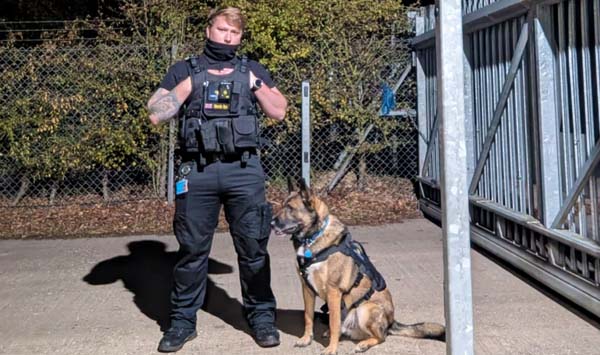
Canine units were introduced to support patrols across the site. Dogs provided enhanced detection capability, deterrence, and rapid area coverage, particularly along perimeter lines and vulnerable access points.
Live CCTV Monitoring
CCTV systems were integrated with mobile devices, allowing patrol officers and supervisors to receive real-time alerts. If a patrol passed an area and movement was detected shortly afterwards, officers were immediately notified. This eliminated blind spots where individuals could wait for patrols to move on before emerging.
Clear Response and Reporting Procedures
All patrol activity, alerts, and incidents were logged and reported consistently. This created accountability, audit trails, and clear evidence of security activity.
Results and Outcomes
Following the introduction of the new security strategy, the site experienced immediate and measurable improvements:
-
No further unauthorised access incidents
-
No repeat perimeter breaches
-
Early detection of suspicious behaviour
-
Increased deterrence due to visible, active patrols
-
Improved confidence among site management
Most importantly, the risk of covert activity was eliminated. The layered approach ensured that no single failure could compromise the site.
Cost vs Value
While the professional patrol solution represented a higher upfront cost than the previous arrangement, it removed the hidden costs associated with ineffective security. The business gained predictability, reduced exposure to serious risk, and avoided the potentially catastrophic consequences of another breach.
The lesson was clear: security that looks cheaper is often the most expensive option of all.
Conclusion
This case study demonstrates that professional patrols are not simply about presence, but about performance. Accountability, technology, and trained personnel working together transform security from a passive cost into an active risk management function.
By replacing ineffective coverage with verified patrols, thermal imaging, canine units, and real-time monitoring, the site achieved meaningful cost reduction through risk prevention rather than reaction.
Cutting corners on security does not reduce risk — it creates it.