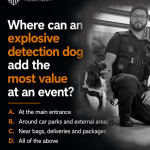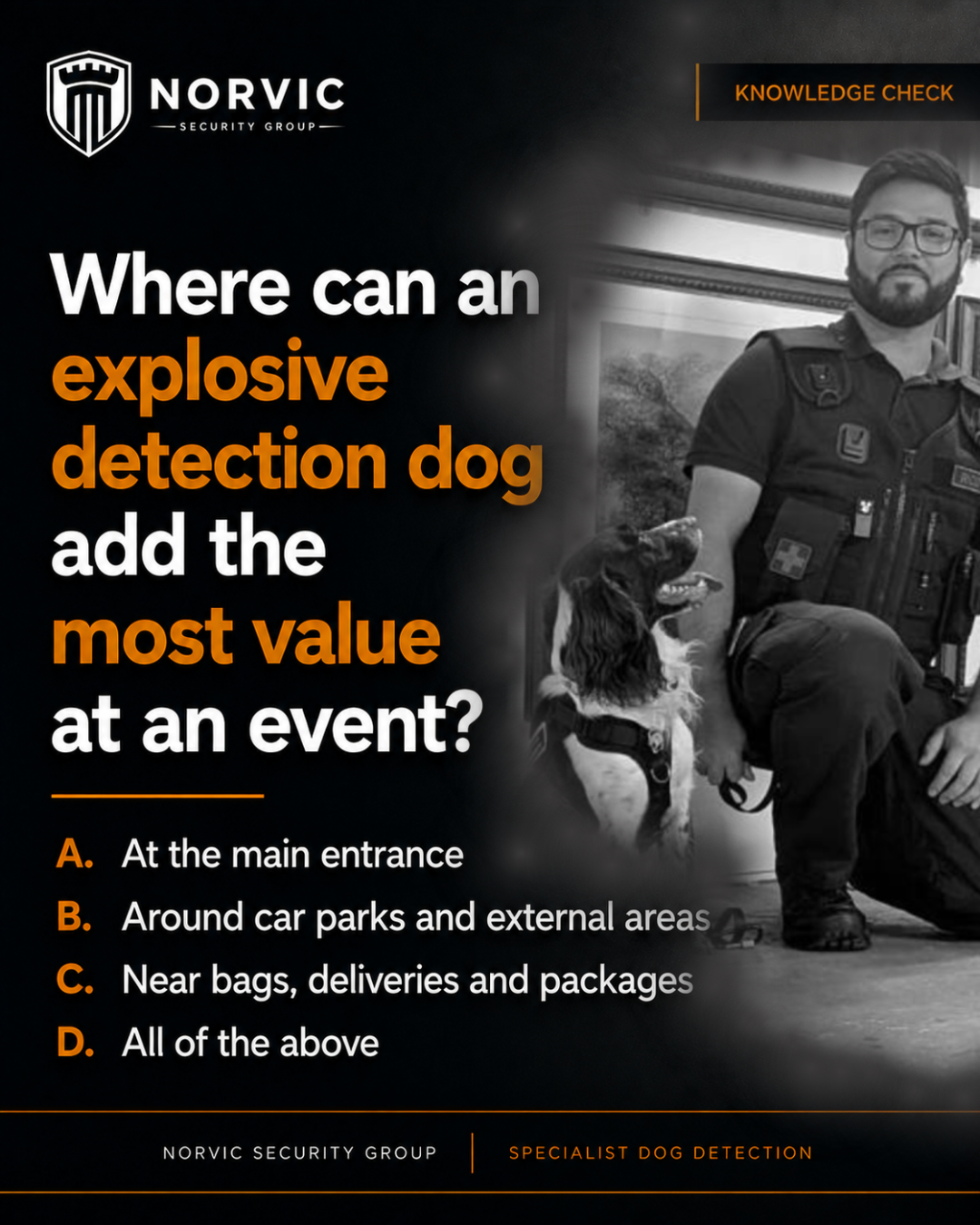
Where can an explosive detection dog add the most value at an event?
When people think about explosive detection dogs, they often picture them standing at the main entrance of a large event, checking people as they arrive. While entrance points can certainly be important, they are only one part of a much wider security picture.
For many events, the real value of an explosive detection dog comes from how flexible and mobile the capability is. A properly trained detection dog and handler team can support different areas of an event site, including spaces that are sometimes overlooked during planning.
So, where can an explosive detection dog add the most value?
The simple answer is, all of the above.
Main Entrances
The main entrance is one of the most obvious places for security focus. It is where guests arrive, tickets are checked, bags may be searched, and staff are often placed to manage access.
An explosive detection dog can add another layer of reassurance at this stage. Their presence can support existing search procedures, help identify potential concerns, and show that the organiser is taking public safety seriously.
However, it is important that this is done professionally. The aim is not to create fear or make the event feel hostile. A well-managed detection dog capability should be calm, controlled and reassuring.
This is especially true when using a dog such as a Springer Spaniel, which does not have the same intimidating appearance that some people may associate with security dogs. The dog is there to work, not to frighten members of the public.
Car Parks and External Areas
Car parks, service roads, drop-off points and external areas can be just as important as the main entrance.
In many cases, these areas are more vulnerable because they are larger, more open and harder to monitor continuously. Vehicles may be parked close to the venue, deliveries may arrive throughout the day, and members of the public may move through these areas before reaching the main event space.
An explosive detection dog can assist by checking vehicles, external routes, suspicious items, and areas where people may gather before entering the venue.
This can be particularly useful for larger public events, hotels, sports venues, festivals, faith venues and high-profile gatherings where the security plan needs to consider more than just the front door.
Bags, Deliveries and Packages
Bags, deliveries and packages are another key area where detection dog support can add value.
Many venues receive deliveries before, during and after an event. These may include catering supplies, equipment, parcels, decorations, stock or contractor materials. In a busy event environment, it can be easy for items to move through different areas without receiving the level of attention they should.
An explosive detection dog can support checks around delivery points, storage areas, unattended bags, equipment zones and backstage or staff-only areas.
This does not replace good access control, staff awareness or search procedures. Instead, it supports them.
Security is strongest when different measures work together.
A Calm and Professional Layer of Safety
One of the biggest misunderstandings about explosive detection dogs is that they are only suitable for high-threat environments. In reality, they can also be used as a preventative and reassuring measure.
The presence of a specialist detection dog team can help organisers show that safety has been considered properly, without making the event feel uncomfortable.
For guests, staff and organisers, that balance matters.
Security should protect people, but it should also support the atmosphere of the event. People should feel safe, not alarmed.
A professional detection dog team understands this. The handler, the dog and the wider security team should work in a way that is discreet, controlled and appropriate for the environment.
Supporting Event Organisers and Venues
For event organisers, venues, hotels, schools, faith venues and public gatherings, explosive detection dog support can form part of a wider protective security plan.
It can be used before guests arrive, during the event, around external areas, or as part of a planned search process. The exact approach will depend on the site, the event, the risk profile and the organiser’s requirements.
The key point is that detection dog support should not be treated as a standalone tick-box service. It should be considered as part of the full security picture, alongside access control, staff briefings, emergency planning, search procedures, CCTV, stewarding and communication.
Final Thoughts
So, where can an explosive detection dog add the most value at an event?
At the main entrance? Yes.
Around car parks and external areas? Yes.
Near bags, deliveries and packages? Yes.
The answer is all of the above.
The real value comes from using the dog and handler team intelligently, placing them where they can support the wider security plan and provide a calm, professional and reassuring layer of safety.
At Norvic Security Group, our focus is on specialist protective security that helps organisers protect people, support staff and create safer environments without unnecessary disruption.
Explosive detection dog support is not about fear.
It is about preparation, reassurance and taking public safety seriously.